
NewsDetails
Analysis of Vibration Characteristics of Automotive Drive Shafts
author:Hongye time:2026-01-26 17:20:36 Click:180
The drive shaft is a critical component in automotive powertrains, responsible for transmitting torque and rotational motion from the transmission to the differential. Its vibration characteristics directly influence vehicle comfort, noise levels, and component durability. Understanding and mitigating drive shaft vibration is essential for modern automotive engineering.
Sources of Vibration:
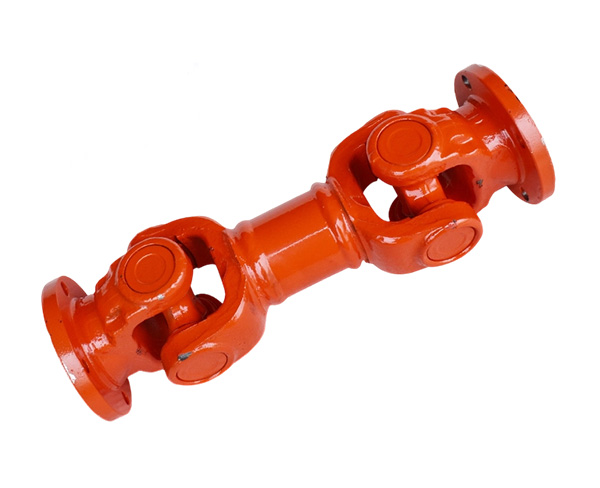
Drive shaft vibrations primarily originate from two sources: mass imbalance and universal joint kinematics. Residual imbalance from manufacturing tolerances creates centrifugal forces proportional to the square of rotational speed, leading to synchronous vibrations. Additionally, Cardan joints (cross-groove type) generate inevitable speed fluctuations during each revolution due to their non-constant velocity characteristics, producing second-order torsional vibrations.
Key Vibration Modes:
Lateral Bending Vibration: This is the most common mode, where the shaft deflects like a beam during rotation. The critical speed occurs when the rotational frequency coincides with the shaft's natural bending frequency, causing resonance (whirling). This depends on shaft geometry, material stiffness, bearing support stiffness, and boundary conditions.
Torsional Vibration: Angular oscillations superimposed on the mean rotational speed. These are excited by engine torque fluctuations and the inertial effects of the universal joints. If the torsional natural frequency is excited, it can lead to gear rattle and increased driveline noise.
Longitudinal Vibration: Axial shaking caused by the sliding motion of slip yokes under friction or by the plunging action of tripod joints, often felt as a shudder during acceleration.
Analytical Methods:
Engineers employ several methods for analysis. Finite Element Analysis (FEA) is used to predict natural frequencies and mode shapes of the driveshaft assembly. Multi-Body Dynamics (MBD) simulations model the entire driveline to study transient responses under load. Experimental Modal Analysis using impact hammers or shakers validates these models.
Mitigation Strategies:
To control vibrations, designers optimize shaft geometry (length, diameter, wall thickness) to shift critical speeds outside the operating range. Using composite materials or adding external damping treatments can alter stiffness and damping properties. Precision balancing to G2.5 or G1.0 grades is mandatory. Tuning the propshaft length and using double Cardan joints or constant-velocity joints can minimize excitation.
In summary, a comprehensive understanding of the dynamic interplay between inertial, elastic, and damping forces is required to design a drive shaft that operates smoothly across the entire vehicle speed range, ensuring reliability and passenger comfort.
 Recommended Products
 Contact us
—— Contact:Manager
—— Tel:+86 15127708111
—— Email:jingzhou999@qq.com
—— Url:https://www.hongyeautopart.com
—— Address:Migezhuang Town, Hejian City, Cangzhou City, Hebei Province, China